As art historians researching the art and visual culture of The Church of Jesus Christ of Latter-day Saints and the broader Latter-day Saint world, we see benefits to more scholarly discourse on race in art within the Church and its culture. The last decades have witnessed a dramatic increase in scholarship exploring race in historical and contemporary Mormonism. Yet much work remains to be done in addressing the role of images in constructing and promulgating Latter-day Saint views on race and ethnicity. Perhaps the critical importance of texts in the Church has overshadowed the communicative power of images. Studying a religion so centrally defined through written words, it’s easy to assume that images are always accessories rather than central to creating meaning—i.e. seeing images simply as illustrations. The naturalistic style typical of Latter-day Saint art (especially in the Church’s first hundred years) doesn’t help, either. Many artists invite us to see their polished, realistic works as straightforward representations of reality, not as subjective visions mediated through religious, cultural, and ideological perspectives.
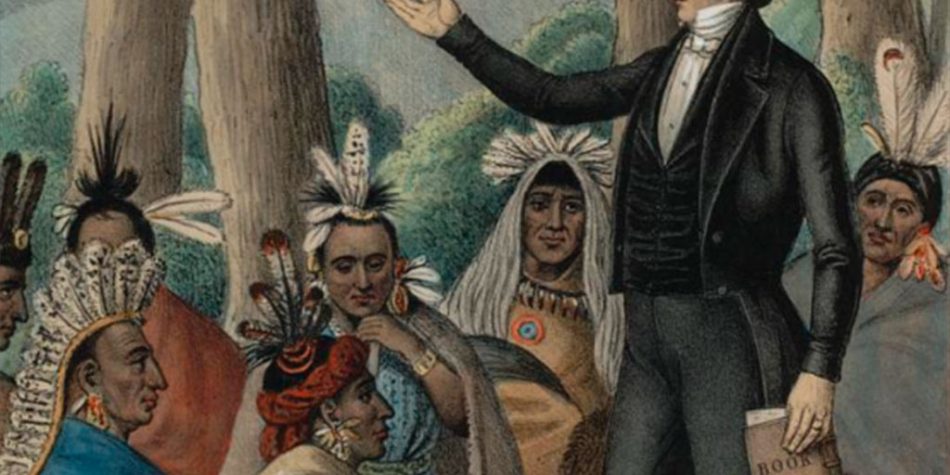
A quick study of just one example suggests how much is missing when images are treated simply as illustrations—and the potential insights images offer into Latter-day Saints’ evolving understanding of race. In 1844, Samuel Brannan engaged the H. N. Robinson Lithography Company to mass-produce an image drawn by Edward Williams Clay depicting Joseph Smith speaking to a group of Native Americans (depicted in the featured image of this article above). The image is more than just a representation of figures who happen to possess particular racial identities. It is an argument about race, employing visual rhetoric to advance specific perspectives about embodied identity in the social context in which it was produced.
For instance, Brannan’s lithograph affirms that the Book of Mormon was a record of the ancestors of Native Americans—Joseph Smith holds a prominently labeled copy at his side. Many early Latter-day Saints were excited by his prophecy that Native Americans would reawaken to their alleged Lamanite identities and join the Latter-day Saint millenarian project. Beyond what it reveals about the Latter-day Saints’ teachings about Lamanites in that period, the lithograph also helps illuminate how this theology intertwined with contemporary understanding in the faith about racial difference. The Native figures are derived from the artist’s imagination rather than observation, but the stereotype they represent is not the “hostile savage” threatening settlement (then ascendant in post-Jacksonian America), but the earlier vision of the “noble savage.” The figures’ regal bearing, elegant ornamentation, and Roman-nosed profiles associate them with the visual tradition of Native Americans as embodying the virtues of an enlightened, natural existence. Many Latter-day Saint viewers were willing, especially in the era before the settlement of Utah, to imagine Native Americans as potential allies rather than opponents. The lithograph captures the optimistic belief that Native people across the continent would join the Latter-day Saint world—the mountains in the background set the image much further west than Nauvoo. How should we address historical artworks that carry spiritual significance to many Latter-day Saints, but may have been perpetuated or been influenced by attitudes of white superiority?
Brannan’s lithograph is not particularly revealing as an illustration of history—it’s an imagined scene generalizing multiple events by an artist who wasn’t present and hadn’t ever seen any of the participants. But when studied as a cultural document, the image offers significant insight into the religious and social perspectives of early Latter-day Saints. This is only one short case study—and much more could be said about this single artwork. But as this example suggests, images offer enormous potential for increasing our understanding of Latter-day Saint views on race.
Recent scholarship on nineteenth-century Latter-day Saint art and visual culture reveals how these images not only documented but also actively participated in Latter-day Saint colonial expansion. Much more work remains to be done. Although there is some scholarship devoted to the intersections of Latter-day Saint culture and race in twentieth and twenty-first-century artworks, this has been neither an extensive nor a sustained enterprise. A deeper analysis of the representation of Native Americans in the paintings of Arnold Friberg and Minerva Teichert, for example, may reveal additional colonialist elements in early Latter-day Saint cultural practices. The recent explosion of interest in depicting the feminine divine in Latter-day Saint art, and in particular Heavenly Mother is also worth noting—reflecting a global church clearly capacious enough to produce images that challenge the long-time Latter-day Saint visual rhetoric that has predominantly represented white subjects. Works by Richard Lasisi Olagunju, Melissa Tshikamba, Kwani Povi Winder, and others point to new and important directions in the contemporary age.
Hence, we are launching an edited volume on race and representation in Latter-day Saint art because existing scholarship only just begins to scratch the surface. There are numerous other topics ripe for exploration: how have Latter-day Saints envisioned Lamanites in the twentieth and twenty-first centuries? How did images promote or challenge Latter-day Saints’ shifting understanding of people of African descent, before, during, or after the “priesthood ban”? How are international members of the Church creating images to represent this vivid diversity in the increasingly global Church? How have Black and Indigenous Latter-day Saints of color fashioned self-representations that challenge racist stereotypes that may remain among some? And how should we address historical artworks that carry spiritual significance to many Latter-day Saints, but may have been perpetuated or been influenced by attitudes of white superiority? We invite scholars of all disciplines and backgrounds to propose essays on these or any other topics related to race in Latter-day Saint visual culture in the hope that more critical discussion will help bring about a better understanding.