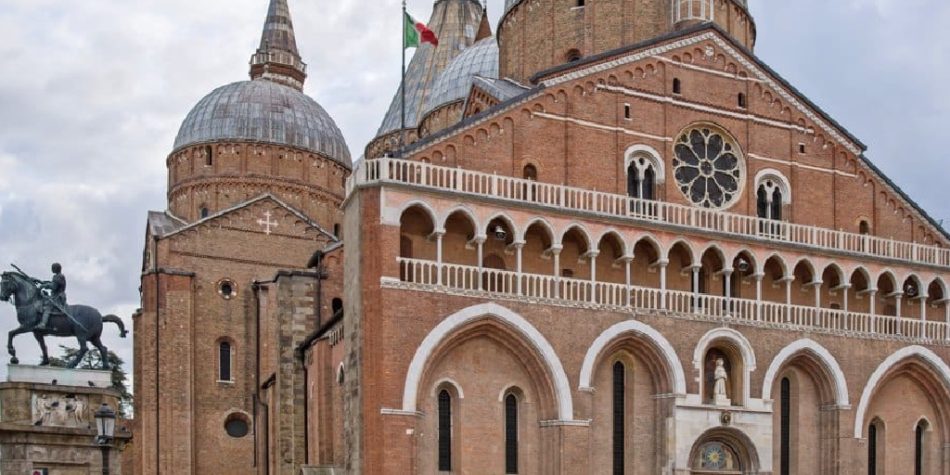
Basilica of Saint Anthony of Padua / joergens.mi, Wikimedia Commons / CC BY-SA 3.0

Did You Witness the First Christmas?

When we feel the “spirit” or “magic” of Christmas, what are we really feeling?
Basilica of Saint Anthony of Padua / joergens.mi, Wikimedia Commons / CC BY-SA 3.0

“The most wonderful time of the year,” produces wonder, joy, love, excitement, and altruism—feelings we often label as the “spirit” or “magic” of Christmas. But what is really going on? Why do we feel these things, even often those of us whose faith in God is weak, wavering, or wanting? 

Is it the tinsel and trees? The gifts and the giving? Family and festive fun? Or is it Santa Claus or perhaps carols like Silent Night? Or reading The Night before Christmas or that “there went out a decree from Caesar Augustus that all the world should be taxed”? Or is it all of it? What is really happening when we feel “good tidings of great joy”?

I am convinced we are feeling much more than we think and that it revolves around two words and two Biblical verses—transcendence, condescension, and Luke 2:13-14.

To explain, let’s explore an experience Henry B. Eyring shared regarding his first experience in the Salt Lake Temple

I looked up at a high white ceiling that made the room so light it seemed almost as if it were open to the sky. And in that moment, the thought came into my mind in these clear words: ‘I have been in this lighted place before.’ But then immediately there came into my mind, not in my own voice, these words: ‘No, you have never been here before. You are remembering a moment before you were born. You were in a sacred place like this.’

I experienced the strongest sense of being in a large, familial congregation like this before, but on the Christmas Eve.

President Eyring experienced a pre-mortal memory entering his present mortality. His memory transcended or “moved beyond the limits” of the veil of forgetfulness—a literal revelation (a word meaning “to part the veil”). It is no wonder he continued, “The temple is a holy place where revelation comes to us easily if our hearts are open to it and we are worthy of it.”

I have experienced two of these transcendent moments where past or present Heaven unexpectedly bursts into my earthly present. They are so real that, for me, they are undeniable. One, like President Eyring’s, occurred in the temple. The other, however, was in a Catholic Basilica on Christmas Eve 1992 in Padova, Italy where I was serving a mission. There were ten missionaries assigned there and together we went to the public square in front of the world-famous Sant’ Antonio di Padova Basilica, a pilgrimage site for Catholics. Thousands were mingling in the crisp evening air, waiting for the building’s massive doors to open for midnight mass. 

We began singing Christmas hymns in Italian. A few people stopped to listen, but with each hymn more gathered. Some tried to give us money, thinking we were street performers! However, on that beautiful night, singers and listeners received so much more than money could ever buy. There, in front of the basilica beautifully bathed in light, the “spirit” of Christmas happened.

The Lord explains that when the Spirit of Truth communicates among people, they “understand one another, and [all] are edified and rejoice together.” That was the “spirit” we felt that night singing and listening to the hymns of Christ’s birth. It was so tangible. We all could feel it and see it in each other’s eyes, Latter-day Saints and Catholics alike. For a moment, the Spirit of Truth parted the veil, and we remembered the love and peace we must have all felt in Heaven looking down on the first Christmas. Little did I know that the veil was about to burst.

When the doors of the basilica opened, thousands filed into one of the largest churches in the world. Annually five million people, mostly Catholic pilgrims from around the world, enter the football-field long chapel with its hundred-foot, vaulted ceilings. We stood three-quarters of the way back from the altar, just ten young American Latter-day Saints in a sea of Catholics packed to the gills inside that massive and magnificent monument to Christ. It was my first time at a mass, and I was confused but intrigued by the beautiful pageantry. Viewing the thousands of faces around us, my initial thoughts were sad. “Just ten of us,” I immaturely judged, “have a knowledge of the truth.” Yet, as the ceremony continued, I found myself responding out loud with everyone to the archbishop’s cues for prayers. A priest then arose and read from Isaiah, “The people that walked in darkness have seen a great light: they that dwell in the land of the shadow of death, upon them hath the light shined.” 

At that moment, all those precious feelings from our previous singing came flooding back. I heard no words, but my heart filled with an immense love for every person standing with me in the basilica and I knew, really knew, that they were my literal brothers and sisters. In addition, I felt their love for God and His Christ and experienced, in part, the Father and the Son’s abiding love for each of them. As I marveled, I was so filled with love that I thought my chest would explode. And then I felt “it.” Again, no words, yet I experienced the strongest sense of being in a large, familial congregation like this before, but on the Christmas Eve. As the congregation sang an unfamiliar hymn, I hummed along embraced by a holy memory so strong I wanted to erupt in praise. 

I became aware that the archbishop was now reading from Luke 2. In my mind’s eye, the story played out with familiarity, but not a mortal one. The story arrived at the angel announcing to the shepherds the birth of Christ and then “suddenly there was with the angel a multitude of the heavenly host praising God, and saying, ‘Glory to God in the highest, and on earth peace, goodwill toward men.’” 

The strongest wave of this memory washed over me and “suddenly” I understood Christmas. The hosts of Heaven had appeared “suddenly,” their joy and praise bursting the veil that could no longer hold them. I then understood why Christmas always felt and feels so different. I understood what really happened on that first Christmas Eve in Bethlehem two millennia earlier.

Amongst all the holiday cheer, we sense deep and powerful memories of when we witnessed our Savior’s transcendent condescension to save us all.

Whether in that heavenly host or another, I had watched with jubilant anticipation the birth of Christ together with you and countless of our brothers and sisters. Our “good tidings of great joy” pierced the veil with praise for our selfless Sibling condescending from the Great I AM to a helpless child. An infant who could not think, speak, or even control His arms or legs—a child “born to die” for us. The scriptures teach that in heaven we “sang together, and … shouted for joy” amidst “heavenly applause,” when Jehovah offered Himself as our Savior. How can we describe the joy, excitement, gratitude, and hope we felt witnessing Him in Mary’s arms beginning His earthly mission? We may not be able to describe it even today, but we surely can continue to feel the power of that memorable night, as the Spirit “brings all thing[s] to [our] remembrance.”

That is why I believe Christmas feels so different, and is powerfully transcendent. Amongst all the holiday cheer, we sense deep and powerful memories of when we witnessed our Savior’s transcendent condescension to save us all. And Latter-day Saints are not alone. Everyone you see, speak to, or interact with this December was shoulder to shoulder with us that night celebrating with veil-piercing, sacred joy, just as I and my fellow missionaries were that holy night in Italy years ago. I walked out of that beautiful basilica with a greater love for God, for His precious Son, and for every child of God—siblings in the holy and joyful chorus of that first Christmas night.

Let us choose to ponder more intently about the birth and mission of Jesus Christ this time of year and those ancient memories of joy, peace, hope, and love will bubble up inside us, just below the surface. As we feel them, perhaps we can slow down, and like the Christ child’s mother “ponder them in [our] hearts.” Then, like the shepherds who suddenly saw, heard, and felt our joyful praises, we can find ways to personally praise God and to light the fires of memory in our brothers and sisters, as we make “known abroad” the love and hope of Christ in word, song, and in going “about doing good.” Then, and only then, will our original praises of “peace on earth and goodwill toward men” be felt and remembered, not by a few shepherds, but throughout our families, communities, and the weary world as a whole.

About the author

Derek Sainsbury

Derek R. Sainsbury (PhD in American History) is a professor at Brigham Young University. His research focuses on the intersections of religion and politics in American history, and he is the author of the groundbreaking book Storming the Nation. He is married to Meredith Pettit, and they have three sons.
On Key

You Might Also Like

Donald Trump in Front of American Flag | Complicated Relationship: Latter-day Saints & Trump | Public Square Magazine | LDS Church and Trump Supporters | Trump & LDS Church

Donald Trump is not Brigham Young

The Washington Post wisely warned against worsening public dialogue. But to get there they made a weak connection to Brigham Young that missed the historical mark.

And Not One Soul Shall Feel Excluded

Principled inclusion can and should be a welcome part of Christian discipleship. But like all virtues, this one can be exaggerated to the point that it is no longer a virtue at all.

Traveling Temple Open Houses

We wanted to draw your attention to an interesting announcement from The Church: https://news-gu.churchofjesuschrist.org/article/yigo-guam-temple-open-househttps://www.thechurchnews.com/temples/2022-05-02/inside-the-new-yigo-guam-temple-and-its-traveling-open-house-252759 A new temple is about to open in Yigo Guam. As is tradition, the temple will be opened for an open house before its dedication. The local area around Guam though includes many different island nations, and COVID-19 travel restrictions are still abundant in the area. The traveling open house, the first of its kind, will include both photos of the temple’s exterior and interior as well as samples of the materials used in construction so that visitors can better appreciate it. Traveling open houses will never have the full-impact of visiting the temple, but it may be a way to invite visitors to learn about the temple in increasingly remote areas in the future. We’re excited to see how this open house goes, and if the plan is revisited in the future.  

Under the Banner of Heaven Episode 6, “Revelation”

Summary – The detectives show up at the Lafferty home to interrogate Ma Lafferty about the whereabouts of Ron and Dan. She claims they are not there. Pyre takes Brother Brady to the basement to interrogate him about the School of the Prophets meetings there. Brady claims that he experienced a “burning of the bosom” during those meetings and questions why Pyre is so sure those revelations weren’t true. In a flashback, Ron travels to Oregon in search of “true Mormonism” from a man named John Bryant. He discovers Bryant’s commune practicing a “free love” version of polygamy and drinking wine, claiming it’s natural and spiritual and that the Word of Wisdom is an outdated part of the temperance movement. During a communal bath, Bryant explains that he’s received a revelation that he is the One Mighty and Strong and asks to baptize Ron. After he does, Ron is overcome with love and kisses Bryant. Ron returns home to find the School of the Prophets working hard to print pamphlets of warning to the Church based on Prophet Onias’s revelations. They demand that polygamy and the priesthood ban for black members be restored. Onias tells Ron he believes that the six Lafferty brothers are chosen to help him in his work. He takes Ron up the mountain to his Dream Mine, where he believes a great treasure is buried under a capstone. Onias tells Ron that he believes Ron is the One Mighty and Strong and that Diana will come back to him when she sees how blessed he is in this work. Later in the episode, Ron writes a revelation to Diana and reads it to the School of the Prophets. They vote on its authenticity and approve it as true, declaring Ron as the one mighty and strong. Meanwhile, in the present, Taba finds a recently sawed-off shotgun and takes this as evidence that Ron and Dan are nearby. When the detectives confront Ma Lafferty, she calls Taba a dark-skinned Lamanite and claims that the only law she’s subject to is the law of God. When they press her, she blames everything on two men who were with her sons, Chip and Ricky, who had long hair and smelled like skunk. In flashback, Allen comes home to Brenda who is distressed about baby Erica’s fever, but Allen refuses to let her go to a doctor until he can figure out whether his brothers are right about not trusting modern medicine. They get into an argument during which he hits her. Brenda stands up and walks out. A little while later, Brenda’s sister comes to take her to the doctor while Brenda’s dad, Bishop Wright, stays with Allen and grills him about being too extreme in his religious beliefs. Meanwhile, Brenda tells her sister she wants to leave Allen because “this is how it started with Diana,” but her sister pressures her to stay or to let her bishop make the decision for her.  At the Pyre’s home, Pyre visits with Bishop Wright and Brenda as he tries to reassure them. The Wrights wonder if Pyre will be swayed by the “power” of the Lafferty name and question what he’ll do if the case causes trouble for people “above.” Pyre swears loyalty to Brenda alone and says that the Laffertys have no hold on him. Brenda’s sister gives Pyre a pile of her sister’s letters, hoping to piece together the events leading up to the murder. After the Wrights leave, Pyre gives his mother a bath. Grandma Pyre admits that she pinched Pyre’s wife and claims “the devil made me do it.” Pyre uses a “fake” priesthood blessing to calm her and get her to rinse her hair. In flashbacks, Diana and Brenda’s letter got her a meeting with a member of the Seventy. The men offer the solution that “true revelation causes an increase in love and appreciation for the brethren.” Allen brings up the Mountain Meadows Massacre as a counterargument, saying that Brigham Young commanded it and it couldn’t have been inspired. The seventies try to push the issue aside, but Allen accuses them of inconsistency and storms out. Brenda asks the seventies to approve a divorce, but instead, they give Brenda a blessing, calling her to bring the Laffertys back into the fold. Brenda takes up this cause very literally, buying forbidden store-bought goods for her sisters-in-law and sending missionaries to talk with them. As a result of this meddling, Matilda arrives on Brenda’s doorstep with a warning: “A wife who alienates her husband from her children risks her life.” Because of this threat, Bishop Low and his wife smuggle Diana and her children out of town, though Brenda insists on staying to carry out her calling. Pyre asks Allen about the likelihood that his brothers will leave Diana alone, but this conversation devolves into a discussion of Pyre’s faith crisis. Allen says he “tried to defeat the Church in my mind and see what was left.” He tells Pyre about a red book in his house that tells “a truer story of our people.” Pyre takes Allen’s book home and is reading it in the car and sobbing when his wife discovers him. He admits that he’s struggling, and she asks him to pray with her. He tries but he can’t. She tells him that she refuses to struggle through this with him and demands that he bear his testimony in church to strengthen their children’s faith.   Church History – Allen brings up the Mountain Meadows Massacre as the ultimate example of how revelation is inherently unsafe and unclear. He claims that Brigham Young ordered the massacre. The historical record about whether this is the case is complex, and beyond my scope of expertise. However, I do know that the Church was much more hesitant to comment about the massacre in the 80s, whereas now it has published an essay about the topic as well as supported the publication of a thorough book